
Your Practice Isn't Growing — But It’s Not For The Reasons You Think.
My mom is a terrific cook, especially when it comes to making soup. But anytime she feels like something is off with her soup, she adds a dash of salt. It’s a rule she was taught somewhere along the way, by someone she believed in, and it’s stuck. It’s an easy fix: when in doubt, toss some salt in.
But sometimes the problem is that she didn’t sauté the onions long enough, or the broth was too weak. Also, her ancient, burnt pots are not doing the garlic any favours. But you know the saying: when your only tool is a hammer, you tend to see everything as a nail.
Most of the group practice owners I coach have their own version of janky pots and “just add salt.” And when that doesn’t solve the problem, they start throwing spaghetti at the wall. Not only is that inefficient, it’s also costly.
I get it, though. When business feels unstable or precarious, we have a natural tendency to ‘act now, strategize later.’ But I don’t recommend it. The most expensive mistake a practice owner can make is misdiagnosing the problem.
As a business consultant to group practice owners, I repeatedly see three distinct challenges in group practice growth. At any given moment, almost all practices are dealing with one of these things, and often they’re dealing with it effectively. A challenge only becomes a problem when something is stuck, messy, or moving in the wrong direction.
The symptoms can look similar from the outside: low referrals, fluctuating caseloads, a minuscule profit margin — but they have different causes, different data signatures, and different solutions. Treating one as another can cost you time and money. And I want to save you a lot of both!
Challenge #1: Marketing
“How can I get more clients into my practice?”
Marketing is a front-door challenge, and it’s got a few obvious tells. Inquiries are low. The practice isn't attracting enough of the right clients, or isn't converting the ones it does attract. Referral sources are thin, or the practice is invisible to the clients it's actually built to serve.
Often when practice owners approach me for help, they assume their struggles are due to marketing. “We need more referrals,” they say. They’re often already spending a lot of money on SEO and ads, creating Instagram posts that their ideal clients will never see, and wondering if they need to set up some networking dates.
Marketing was always the thing my anxiety landed on when I was building my practice. I anxiously patrolled my referral numbers and fretted that they were too scarce. I saw a business coach who convinced me to invest (a lot of) money into GoogleAds. And this did increase referrals…but somehow, the therapists on my team still weren’t busy enough. It was like pouring Champagne into a leaky bucket. Like, premium Champagne.
I cannot tell you how many times I see something like this happen.
Saying that you have a marketing problem and then dumping money into GoogleAds is the classic “just add salt.” Imagine your knee had been bothering you for months, and you just kept icing it and limping on? Personally, I’d want to get an MRI so I knew what was really going on.
Data and analytics are your business’s version of an MRI (and way easier to access than medical imaging in Canada). If my practice wasn't getting many inquiries or bookings,even after paying for ads, I’d deep dive into three things before spending another cent:
My ad insights. How many leads are my ads driving to my website?
My google analytics (there are some specific markers that reveal a lot)
My website copy and CTAs (most people’s website copy is written for therapists, not clients)
When I meet with practice owners, this is part of our first order of business. Book a free call and we can get our finger on the pulse of where there’s drain, and where there’s opportunity.
Challenge #2: Optimization
“Everything seems disconnected, disorganized, and frustrating.”
Optimization is one of those vague, business-y words that doesn’t immediately tell you very much. For your practice’s purpose, optimization referrs to your systems, procedures, and service flow. Clients are seeking you out, but your operational environment is working against retention and revenue.
Optimization challenges are a really common growing pain in a clinic. Some examples I’ve seen in the practice owners I have helped include:
Bricks and mortar clinics who under-utilize their space
A lack of procedure for addressing frequent cancellations
Therapist availability doesn’t match the days and times that clients demand
The booking and selecting a therapist process is confusing, overwhelming, or too slow
You’re hiring therapists who aren’t the right fit for your needs
These are structural and systemic conditions that slow down bookings, elevate operating expenses, and stall revenue regardless of how good the clinical work is.
Knowing where the optimization weaknesses are in a practice requires a review of your systems and a handle on some data. Sounds boring I know, but I nerd out on this stuff. Running my own group practice for 5+ years and coaching countless other practice owners has made me intimately familiar with systems that work and systems that don’t (and which numbers to check to alert us). And there are few things I love more than saving you time and helping you make more money. You deservie it, and so do your therapists!
If you want an expert eye to review your operations and see what needs to be tweaked, the best place to start is a free clarity call. You’d be surprised at how much you can learn about your business in 30 minutes!
Challenge #3: Performance
“I don’t understand why my therapists can’t hang onto their clients!”
The other thing I hear a lot about from group practice owners is concerns about what’s going on in their therapists’ sessions. Performance is a clinical problem. It’s also the trickiest of the challenges for you, as a group practice owner, to intercept, because you can helicopter parent all you want, but you don’t actually know what’s going on in the room or on the screen.
But you might have your hunches. You’re surveilling your clinic calendar, clicking into various reports (if you even know what reports to run). You’re probably seeing:
clients that don’t have an upcoming session booked
clients whose visits seem to be taking place irregularly and at longer intervals
consultations that didn’t result in a booking.
With each click, your frustration builds, but so does your confusion. Because this therapist who isn’t retaining clients? You really like her. You’d recommend her to your sister. And then there’s the internal tension you have: you want your practice to be successful, and you want these clients to get the help that consistent appointments and an established treatment plan can give them. But you don’t want your therapists to think you’re micromanaging them. Plus, you’re starting to feel like a broken record.
I’ve dedicated a tremendous amount of research and time into developing tools and training to help practice owners refine their team’s performance and improve client retention. This is my favourite lever to pull in my own team, and in the practice owners I help, because when therapists perform well, clients benefit. And, I will scream this from the rooftops: client retention is a client-centred endeavour!
If you’re curious about the training I created for therapists in group practices, check out my Client Retention System. It’s the only program I know of its kind, and the feedback from therapists and group practice owners alike has been overwhelmingly positive.
Why it can be tricky to diagnose your own business problems
What makes misdiagnosis so common is that the symptoms genuinely overlap. A therapist whose caseload keeps thinning out might have a performance problem — or she might have been handed a schedule that makes continuity impossible. Low bookings for a new hire might mean nobody knows she exists, or it might mean your intake process isn't matching clients to the right fit. The data looks similar. The cause, and the fix, are not
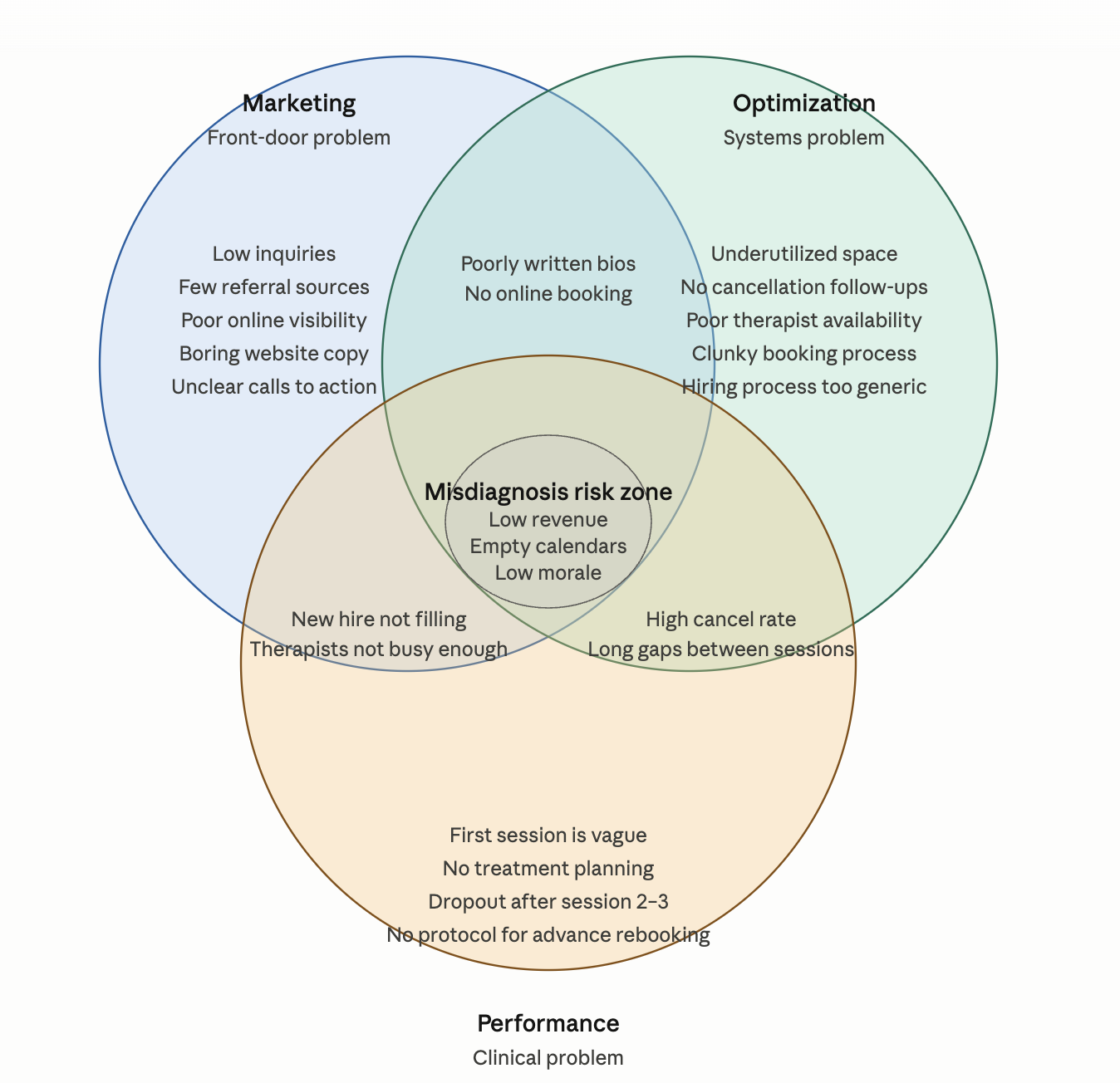
Before drawing conclusions, we need to determine the root cause first, and rule out the usual suspects. And that takes data. Without analytics and key performance indicators, we’re going on emotions and assumptions. And we know what the research says about that approach (it’s dubious).
A therapist with a high cancellation rate and low average number of visits per client may have a clinical problem. Or she may have caseload full of clients with complex circumstances, or working shifts that are good for her lifestyle but bad for clients, or hasn’t been adequately coached on how to book multiple sessions in advance with clients. The data looks the same. The response is completely different.
Optimization before performance. Context before competence. Always rule out variables before leaping to solve the problem you assume you have. This sequencing isn't not only more fair to your clinicians, it's also more likely to lead to accurate problem solving. Structural problems are common and correctable. Sending someone to training when she needs to fix her schedule is a waste of her time and yours, and it damages morale. And performance coaching can be enormously impactful, as long as you’re coaching the right thing.
The diagnostic question at this stage: is this pattern showing up across the team, or is it specific to one person? If it's everywhere, look at the system. If it's isolated, look closer. First look at the operational conditions first, and then examine your performance indicators for the therapists.
Have I mentioned that data is my love language? If you’re a Jane user who wants to get a handle on some of your therapists’ key performance indicators, I put together something you’re gonna love. Download my Retention Audit for free.
The cost of getting it wrong
Investing a lot of money into marketing a practice with a performance problem produces a faster churn cycle, not growth. More referrals, more first sessions, but more early dropouts. You spend more, and the underlying problem gets harder to see because the new client volume creates the illusion of momentum.
Clinical development investment in a practice with an optimization problem demoralizes good clinicians and produces no measurable change in outcomes. The therapist attends the training, returns to the same structural conditions, and the numbers stay flat. She starts to wonder if she's the problem. It’s like constantly painting a bedroom where there’s a moisture problem. The paint won’t stick until the foundational issue is addressed.
And when it comes to actual perfromance issues, there are multiple components to clinical performance that make a significant difference to your bottom line. Retaining a client for a full course of treatment (usually a minimum of eight sessions). Regularly spaced appointments. A high first session or consultation conversion rate. A low cancellation rate.
Highlighting the precise issues that need attention protects your time and resources, and ensures that the therapists on your team are being supported in the right ways. And if therapist performance is indeed the issue, the data can point you in the right direction to help them.
Where do you go from here?
Maybe you’re reading this hanging your head because you haven’t been tracking metrics and don’t know how to start. Or perhaps you already know that challenge you’re facing, but feel overwhelmed with the tasks ahead of you to get on track.
This is usually when people reach out to me. Whether you need help getting started with tracking metrics, a strategic guide directing you on the path forward, or someone who isn’t afraid to (lovingly) help you get out of your own way, I’m happy to help.
The best place to start is always with a free, zero pressure call. It’s never a waste of time, and I’ll be happy to make a connection with you.